
Camel’s Hump, Mount Macedon
Introduction to the Macedon Ranges
Located less than an hour drive from Melbourne, the Macedon Ranges is a popular visitor destination, highly regarded for its rural landscapes and natural environments, the iconic natural landmarks of Hanging Rock and Mount Macedon, the unique character of its heritage villages, food and wine, and the local artisan culture.
The key strengths of the region are:
· Nature based tourism
· Artisan villages
· Food, wine and ferments
· Festivals and events.
The Macedon Ranges is part of the Daylesford and Macedon Ranges tourism region, and promotes its overarching brand position as “rejuvenation”.
Our Tourism Sub-Regions
We speak of nine tourism villages in the Macedon Ranges. These are:
• Gisborne • Kyneton
• Lancefield • Macedon
• Malmsbury • Mt Macedon
• Riddells Creek • Romsey
• Woodend
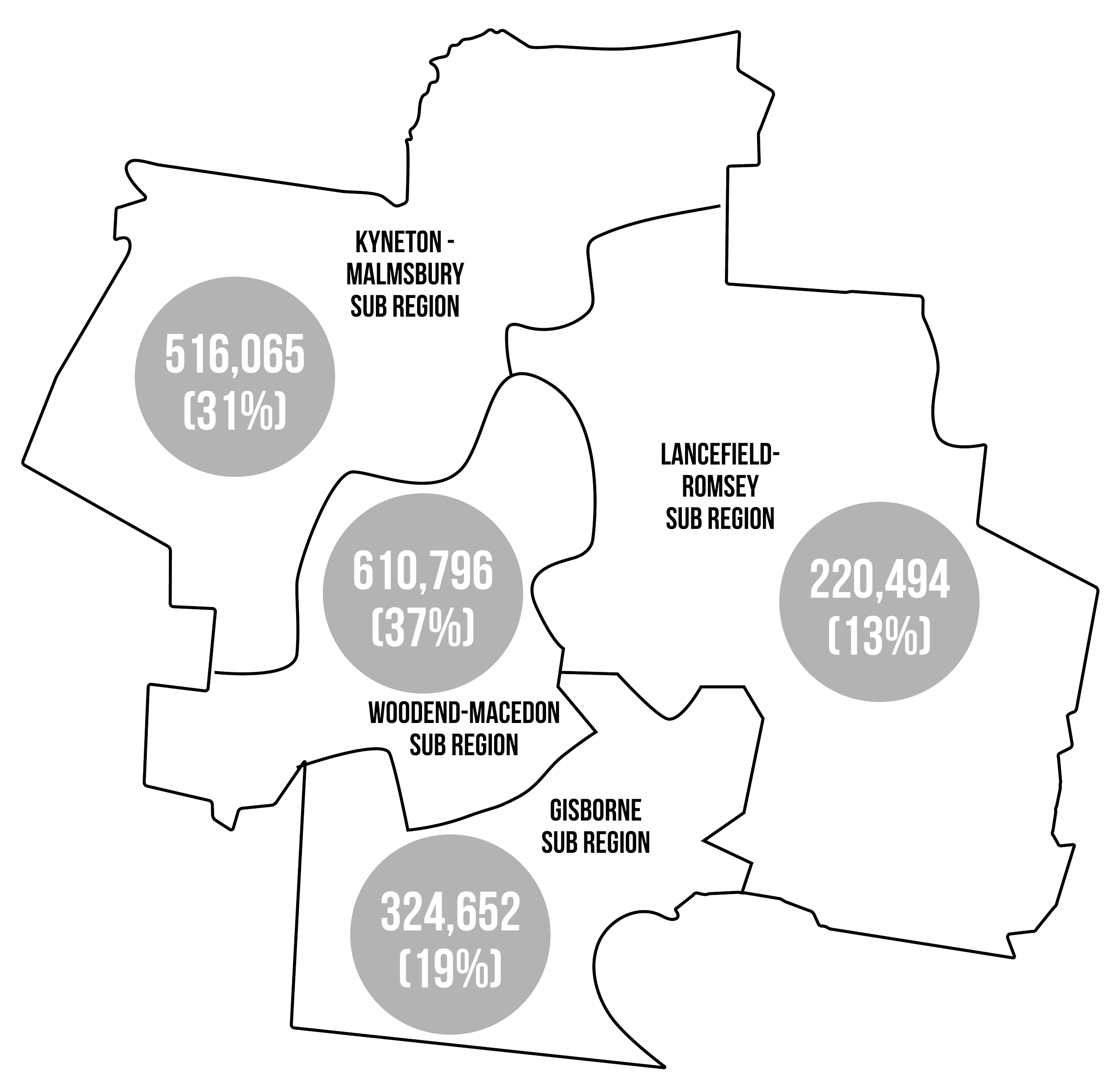
The Macedon Ranges is broken into four tourism sub-regions and the average visitor numbers to each can be seen on the following map.
UNDERSTANDING WHO’S WHO IN TOURISM
The State of Victoria is divided up into a number of tourism regions. The Macedon Ranges forms part of the Destination Central Victoria
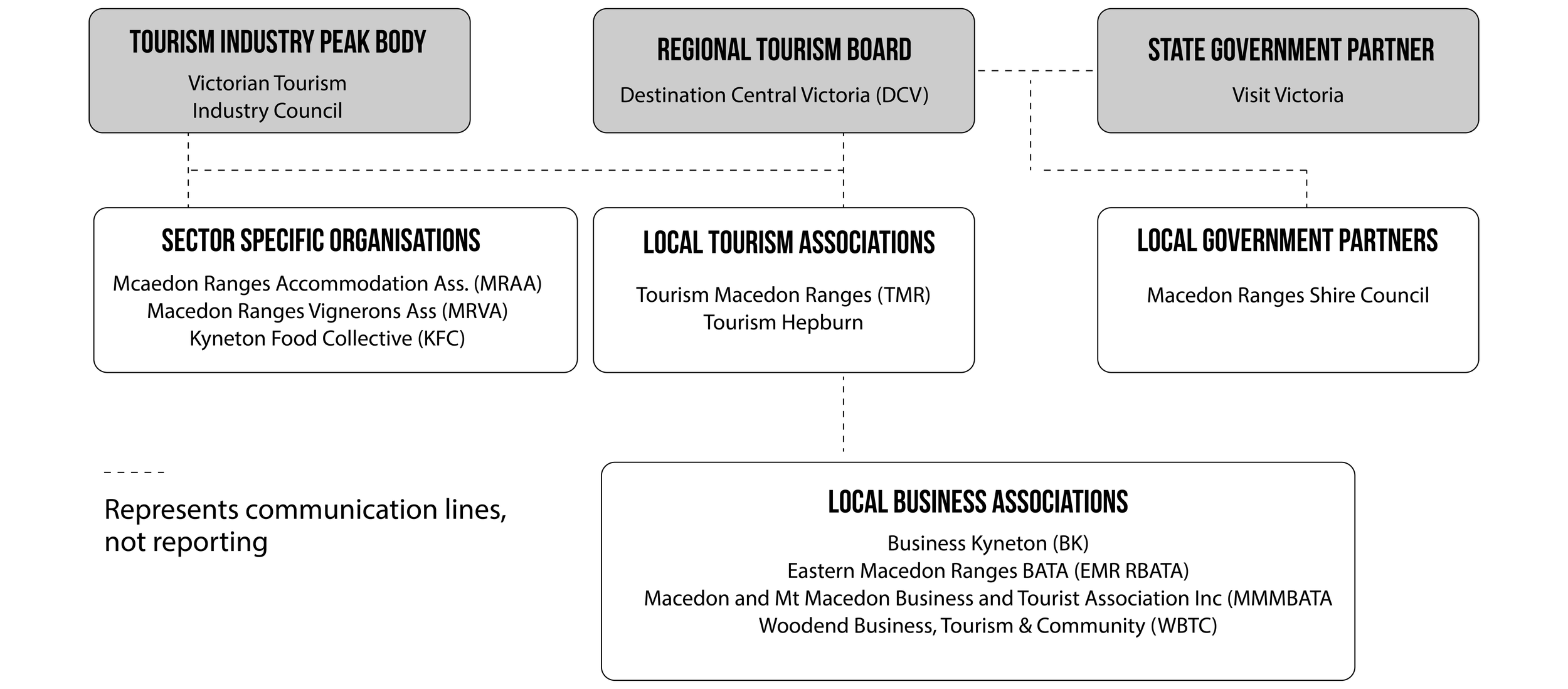
The key tourism groups active in our region are:
-
Visit Victoria (VV) is the State Government authority responsible for the marketing of the State's tourism industry. They drive the State’s tourism strategy and produce the large-scale advertising campaigns. In order to grow regional tourism, Visit Victoria supports the work of the State's ten Regional Tourism Boards.
More information can be found at:
-
The peak industry body for tourism in the Hepburn, Macedon Ranges, Mt Alexander and Central Goldfields region
As a Visitor Economy Partnership (VEP), the organisation is governed by a Board which includes senior local government representation and industry experts.
The role of Destination Central Victoria (DCV) is to develop a co-ordinated approach to marketing, product development, infrastructure development and industry development for the region.
DCV are are an independent body, operating as a not-for-profit business, where all profits are reinvested back into developing and promoting the region. State and local government are key financial stakeholders in the organisation, providing core funding that underpins the organisation’s operations.
-
Victoria Tourism Industry Council is Victoria’s peak tourism industry body and is the leading advocate for Victoria’s tourism and events industry. They represent over 1,000 businesses, providing opportunities for members to connect and keep informed on the latest research, policy development and impacts that shape the Victorian visitor economy.
For more information:
-
Two local government authorities are actively engaged in tourism within the DMT region. These are Macedon Ranges Shire Council and Hepburn Shire Council. Councils are responsible for visitor servicing and dispersal within their Shire’s as well as visitor amenity and facilities.
More information can be found at: -
The two-local tourism organisations in the region are Tourism Macedon Ranges and Tourism Hepburn. LTA’s are typically focused on industry and community engagement, advocacy, support and in some cases localised destination promotion. Tourism Macedon Ranges’ primary role is as a representative body and voice for industry with the key priorities of Advocacy, Communication and Support.
-
The four active sector groups in the DMT region are Macedon Ranges Accommodation Association (MRAA), Macedon Ranges Vignerons Association (MRVA), Kyneton Food Collective (KFC) and Daylesford & Macedon Produce (DMP is managed by DMT). Their primary roles are to represent and provide a voice for their members.
For more information on these organisations:
MRAA : www.macedonranges.org.au
DMP : www.dmproduce.com.au
MRVA : www.macedonrangeswine.com.au
-
There are three active BATAs in the Macedon Ranges. Their primary roles are networking, advocacy and facilitating opportunity for members.
Business Kyneton (BK) : www.businesskyneton.com.au
Macedon & Mt Macedon (MMMBATA) : www.mountmacedon.org.au
Eastern Macedon Ranges (EMR BATA) : www.easternmacedonranges.au
WHAT IS THE “VISITOR ECONOMY?”
And why is it important to the Macedon Ranges?
The term “visitor economy” refers to the total value of tourism to the region. This includes not only direct expenditure in tourism businesses such as hotels and restaurants, but also indirect tourist expenditure in businesses not directly related to tourism, such as petrol stations and retail shops, and the businesses who support tourism businesses.
The Visitor Economy is the largest private sector contributor to the Macedon Ranges economy in terms of value and jobs.
Not only is the visitor economy vital for the economic sustainability of the Macedon Ranges, it also makes a substantial contribution to the lifestyle so valued by residents. The many restaurants, cafes, services, events and experiences on offer would not be sustainable without the business of visitors.
The 2017 Macedon Ranges Visitor Economy Impact Study reported that Direct Visitor Expenditure, i.e money spent in tourism businesses, contributed $274 million to the Shire’s economy while a further $183 million was contributed by Indirect Tourism Expenditure. Indirect Tourism Expenditure is money spent by visitors in businesses not directly related to tourism, for example, petrol stations, gift shops, general retail, medical centres etc.

The total contribution of the visitor economy to the Shire’s economy was $457 million making it the largest private sector contributor, following government and health.
Based on this data, the Macedon Ranges is reliant on Tourism if it is going to remain economically sustainable into the future.
Macedon Ranges Visitor Economy Strategy
In 2019 the Macedon Ranges Shire Council endorsed and adopted the Macedon Ranges Visitor Economy Strategy 2019 - 2029. Tourism Macedon Ranges and a team of stakeholder group representatives were part of the Visitor Economy Reference Group who worked on this project.
This document provides an overview of the visitor economy in the Macedon Ranges and provides valuable information on visitors and visitation behaviour, the value of the visitor economy, products and experiences, and opportunities and challenges in the Shire. It is worth taking the time to read this document. A link is provided below.
Supporting the strategy is a two-year Action Plan detailing specific activities, responsibilities and deadlines for delivery by Council and Tourism Stakeholders

Regional Destination Management Plan 2024-2029
The region’s Destination Management Plan provides an overview of the tourism region and its strategic direction
Regional Branding
The Daylesford Macedon Ranges is one of Australia's fastest-growing tourism regions, known for its compact diversity and four key brand pillars. It excels in food and drink, boasting more awards per capita than any other region, thanks to its fertile soil and pure mineral water.
The region is a wellness hub, offering abundant fresh mineral water, spa treatments, and nature activities. Its rich history includes Indigenous appreciation of the mineral springs and charming villages from the gold rush era.
Additionally, the area's vibrant arts scene features classes, workshops, galleries, and festivals, attracting artists and creatives for decades.
Below is a table showing the four elements or “pillars” of the regional Daylesford Macedon Ranges brand with some further points of explanation on each pillar.
It is important to understand the regional branding and target market, what experiences are on offer, what promotional resources are available, the messages being communicated and new products under development if you are going to identify and tap in to opportunities.
It will also help guide you in how you speak about the region.
-
Rich soil and famed mineral water
World-class produce (food and drink)
Farm to table provenance
Artisanal producers and growers
-
“I want an experience”
Pre-kids and empty-nesters
Discerning
Socially and environmentally aware
Prefer quality over quantity
Financially secure
-
Explore premium cool climate wineries
Eat at a hatted restaurant
Explore a farmers’ market
Forage for produce
Grab fresh produce at a farm gate
Join a cooking class
Mineral water straight from the source
-
Lavandula harvest festivals
Budburst
Spudfest
Art in the Vines
Kyneton Daffodil & Arts
Agricultural shows
Harvest festival
-
We have 80% of Australia’s mineral springs
We led the way with farm-table provenance
Sophisticated cool climate wine region
The richness and purity of land and water
Specialist farmers (British Whites etc)
Distinct seasons and produce
Meet the producers at cellar doors and Farmers’ Markets
-
Wineries
Restaurants
Farmers’ Markets
Farm gates
Dairy Flat Farm
Planned:
The Institute of Gastronomy
FOOD & DRINK - INDULGE
-
Nature: Goldfields Track, Hanging Rock etc
Healing: Spa, massage and treatments
Indulgence: Eat/drink local produce
Amazing accommodation
-
“I’m busy and want a break”
Pre-kids and empty-nesters
Discerning
Financially secure
Families
Corporate groups
Wedding groups
Girls weekends
Financially secure
-
Walk or ride through the bush
Treat yourself with a spa and massage
Wander around beautiful gardens and lakes
Indulge in the best regional produce
Choose from a variety of accommodation
Explore Botanic Gardens
Financially secure
-
ChillOut
Cycling events and races
Clunes Comedy FestivalAgricultural shows
Harvest festival
-
World-famous and iconic Hanging Rock
Mt Macedon Memorial Cross
Macedon open gardens
For decades, a centre of healing
Balanced: be well then indulge
World-class Nature-base tourism assets: Creswick Trails, Goldfields
Track, Hanging Rock
Wildflowers and slow flowers
-
Wine/e-bike tours
Goldfields Track
Hanging Rock enhancements
Planned:
Woodend-Daylesford rail trail
Mineral springs enhancement
Creswick mountain biking
Wellness resort – Musk
ESCAPE & REJUVENATE - REFRESH
-
Charming villages
Gold era history
Swiss-Italian influence
Indigenous culture
-
“I want to understand our culture”
Families
Empty nesters
International market
School groupsFinancially secure
-
Explore charming villages by bike or car
Learn about the gold rush era
The sad tale of the Lost Children
Chinese, Swiss Italian and Gold Rush history
-
Swiss Italian Festival
Malmsbury Village Fayre
Agricultural shows
Harvest festival
-
Village fairs
Dozens of villages with 150 year history
Mineral water and its history
Touring the villages (like Europe)
Yandoit’s stone houses
Lancefield (Ned Kelly, megafauna)
Chinese burial ground – Vaughan Springs
-
Spa country railway
Goldfields Track
Planned:
Megafauna & Dinosaur experience
Indigenous tourism plan
Mineral Springs upgrades
HISTORY & CULTURE - LEARN
ART & ARTISANS - MAKE
-
Thriving art and literature scene
Lost trades, learned in classes & workshops
Outdoor – sculptures and installations
Performing arts and live music
-
“I want to connect to creativity”
Gen Y
Pre-kids and empty-nesters
Discerning
Curious and intelligent
Girls weekends
-
Classes and workshops
Open studios
Learn a lost trade
Buy unique art
Explore an art installation
Meet artists in residence
-
Kyneton Music Festival
DMR Open Studios
Woodend Winter Arts
Booktown
Words in winter
Macedon Writer’s Festival
Classes & workshops
-
Art trails
Festivals celebrating art and literature
Lost Trades
Local characters e.g. Lord Bloomfield
-
Art installations
Creswick of the Lindsay’s
Open studios
Daylesford Macedon Tourism (DMT) offers a number of membership options depending upon your support requirements. Details can be found at www.dmrtourism.com.au.
Tap into publicity opportunities by continually supplying DMT with news and stories for possible inclusion in their PR and social media program.